
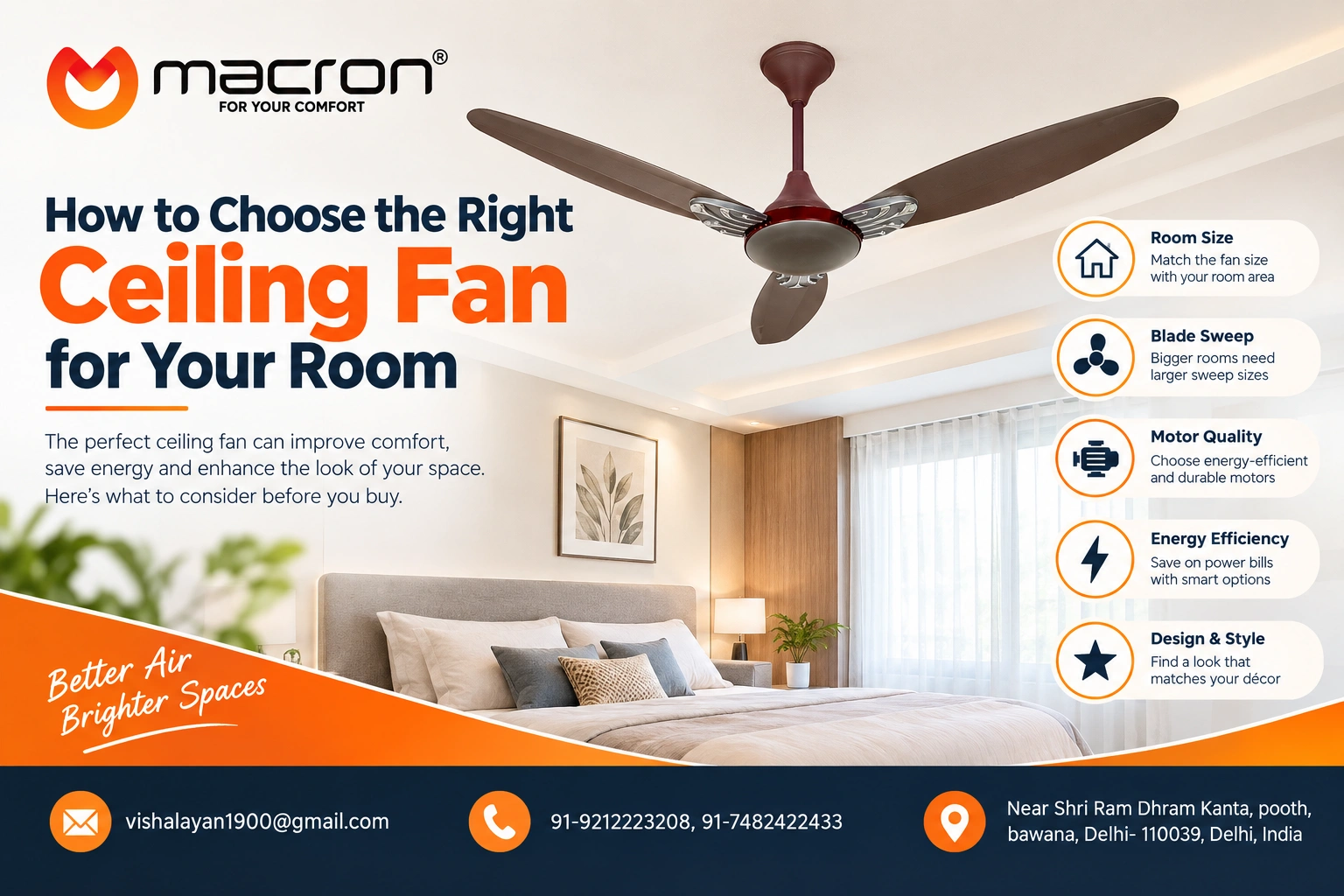
A ceiling fan is a device that moves air. The way a ceiling fan works depends on things not only on the size of the blades or how a ceiling fan looks. The amount of air a ceiling fan delivers, how efficient the motor is, the shape of the blades, how far a ceiling fan’s blades reach, how high a ceiling fan is installed, and how much power a ceiling fan uses all work together to decide how well a ceiling fan moves air.
When a buyer wants the right ceiling fan, the buyer should look at these things and compare them to the size of the room, the condition of the ceiling, and how many people will use the space. How many hours a ceiling fan will run each day. This ceiling fan buying guide from Macron shows the things that a buyer should look at before picking a ceiling fan.
Factors to Choose the Right Ceiling Fan for Your Room:
1. Match Sweep Size to Room Area:
The first step in understanding how to choose a ceiling fan is selecting an appropriate sweep diameter. The fan must generate sufficient air circulation across the usable area without being oversized for the room.
Typical requirements include:
- Small rooms: 900–1050 mm sweep
- Medium rooms: 1200–1250 mm sweep
- Large rooms: 1400 mm or higher sweep
For larger rooms, installing multiple appropriately positioned fans can provide more uniform air distribution.
2. Evaluate Motor Technology and Air Delivery:
Motor technology directly affects a fan’s efficiency, operating stability, and electricity consumption. Traditional induction motors remain widely used, while BLDC motor technology offers a more energy-efficient alternative for high-duration operation.
Do not judge performance only by RPM. A technically sound comparison should consider air delivery, wattage, speed regulation, motor efficiency, and operating noise together. Higher RPM does not automatically mean better cooling if airflow distribution is inefficient.
Also Read: How To Choose The Best Ceiling Fan Manufacturers In India?
3. Consider Blade Geometry:
Blade length, pitch angle, profile, material, and aerodynamic design influence the volume and direction of air movement.
A properly engineered blade profile can improve air delivery while maintaining balanced rotation and reducing unnecessary turbulence. Therefore, blade count alone should never be the deciding factor when selecting a ceiling fan.
4. Check Ceiling Height and Installation:
The distance between the fan and the floor has a direct impact on air circulation and user safety. Standard ceiling heights generally accommodate conventional mounting arrangements, while high-ceiling applications may require a suitable downrod.
For lower ceilings, appropriately designed low-profile installations can maintain safe clearance without compromising practical airflow.
5. Compare Energy Consumption:
A fan operating for 8–12 hours daily can contribute significantly to household electricity consumption. Consequently, wattage and motor efficiency should be important purchasing criteria.
Check the fan’s rated power consumption, BEE energy rating where applicable, and motor technology rather than comparing models only on purchase price. An energy-efficient fan can offer a lower total cost of ownership over its service life.
6. Select According to Room Application:
The best ceiling fan for room use depends on how that room is occupied.
- Bedrooms: Prioritize low noise, smooth speed control, and energy efficiency.
- Living rooms: Consider wider air distribution and suitable sweep size.
- Kitchens: Select dependable models capable of regular, extended operation.
- Offices: Focus on consistent airflow, efficiency, and quiet operation.
This application-based approach produces a more reliable ceiling fan selection than choosing purely on aesthetics.
7. Look Beyond the Specification Sheet:
Long-term performance depends on bearing quality, electrical insulation, balancing, thermal management, structural integrity, and manufacturing consistency. Long-term performance is also helped by features such as controls, timers, and multiple speed settings, but core engineering should remain the priority.
Also Read: Top 10 Ceiling Fan Manufacturers In India
Choose Performance, Not Just Appearance:
The right ceiling fan should provide a balanced combination of air delivery, motor efficiency, durability, acoustic performance, safety, and energy consumption. A technically informed selection helps ensure consistent comfort while controlling operating costs.
Macron focuses on engineering ceiling fans around dependable motor performance, efficient air circulation, quality construction, and contemporary design. Explore Macron’s range to select a fan engineered for the requirements of your room.
Frequently Asked Questions
A 900–1200 mm sweep is generally suitable, depending on bedroom size and ceiling height.
Yes. BLDC motors typically consume less electricity and are well suited for fans operating for extended hours.
Not necessarily. Effective cooling depends on the combination of RPM, air delivery, blade design, and motor efficiency.
Compare rated wattage, BEE star rating where applicable, motor technology, and expected daily operating hours.